Grace Poole
Grace Poole is the keeper of Thornfield Hall's most terrible secret: the existence of Bertha Mason, Mr. Rochester's mad wife, confined to a windowless cell on the third storey. Her presence is the mechanism that allows the household to function while hiding a violent, incarcerated woman, and her peculiar, unflappable character makes her one of the novel's most unsettling figures—a woman who seems utterly ordinary yet is party to extraordinary horrors.
Identity and Role
Grace Poole is a woman of between thirty and forty, with a "set, square-made figure, red-haired, and with a hard, plain face" . She is employed as a seamstress and housemaid, but her true function is far more specific: she is the paid attendant of the lunatic Mrs. Rochester, hired from the Grimsby Retreat . She lives in the third-storey rooms, descending to the kitchen only once a day to eat her dinner, smoke a moderate pipe on the hearth, and carry back a pot of porter for her private solace . Her wages are remarkably high—Leah reports that Mrs. Poole receives five times what the other servants earn, and that she goes every quarter to the bank at Millcote, saving enough to keep herself independent . This unusual arrangement, combined with her isolation, marks her as someone set apart from the rest of the household, a figure whose true business is known only to Mr. Rochester.
The Laugh and the Mask
Grace Poole is first encountered through her laugh—a "curious laugh; distinct, formal, mirthless" that Jane hears while exploring the third-storey corridor . It is a "demoniac laugh—low, suppressed, and deep" , and Jane later hears it at the keyhole of her own chamber door on the night of the fire . Yet when Grace appears, she is anything but demonic: she is a "hard-featured and staid" woman who gives monosyllabic replies and seems to have "no point to which interest could attach" . This disjunction between the eerie sound and the mundane person is central to her function. She is a living mask, a figure whose ordinariness is itself a form of concealment. When Jane confronts her the morning after the fire, Grace shows "absolute impenetrability" , coolly explaining away the incident as an accident and even cross-questioning Jane to see what she knows . Her self-possession is so complete that Jane is left "absolutely dumfoundered" .
The Keeper's Failures
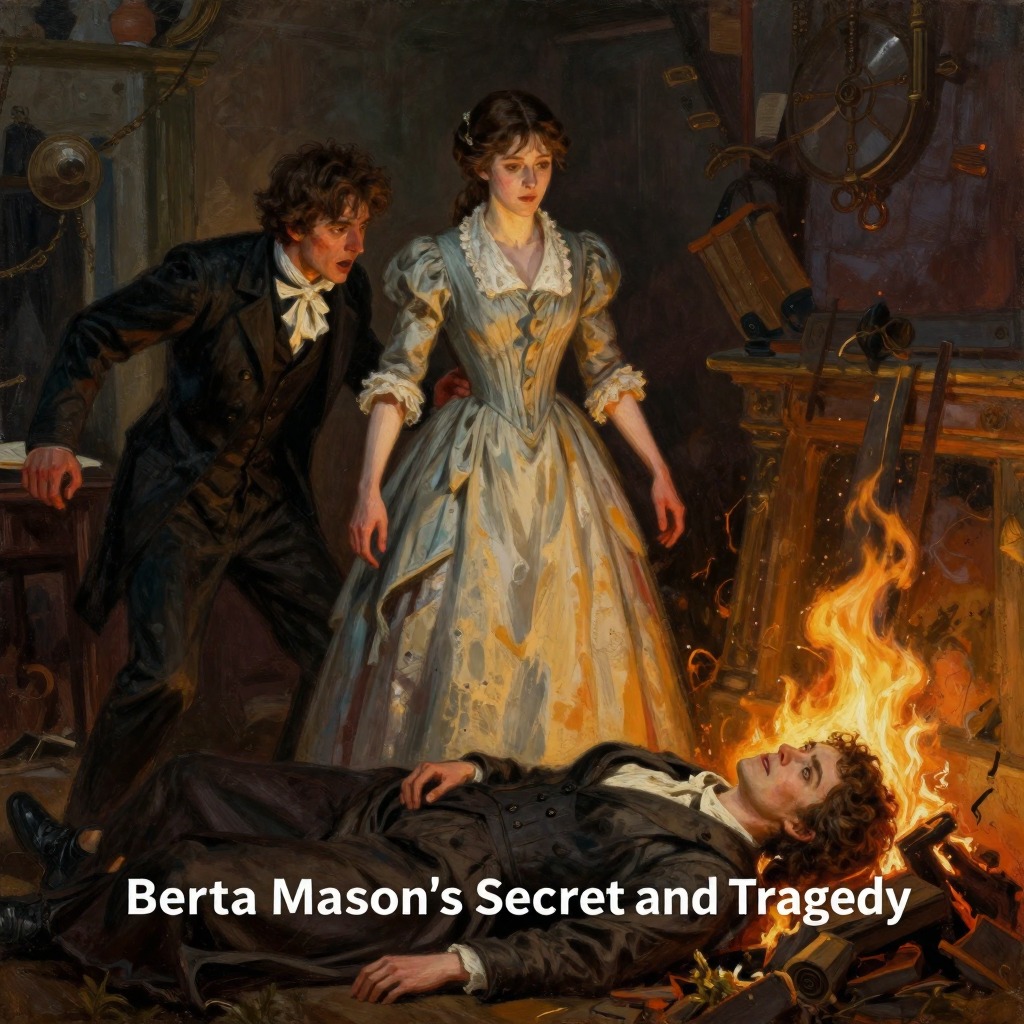
Despite her apparent reliability, Grace Poole's vigilance has lapses that prove catastrophic. Mr. Rochester explains that she has a fault "incident to her harassing profession"—she keeps a private bottle of gin, and when she drinks too much, she falls into a deep sleep . During these intervals, Bertha has twice managed to obtain the key to her cell: once to secrete the knife with which she stabbed her brother Richard Mason, and once to set fire to Mr. Rochester's bed . On the night of the fire, Grace was asleep after her gin, and Bertha took the keys, roamed the house, and kindled the curtains . The final catastrophe—the great fire that destroys Thornfield—also occurs when Grace is incapacitated by drink, allowing Bertha to set fire first to the hangings of her own room, then to the governess's former chamber, and finally to ascend to the roof, where she hurls herself to her death . Grace Poole's failure is thus the direct cause of the ruin of Thornfield and the death of her charge.
Narrative Significance
Grace Poole is a figure of structural necessity in the novel's Gothic architecture. She is the human lock on the door of the secret, the person whose mundane presence makes the extraordinary concealment plausible. Her very ordinariness—her porter, her pipe, her sewing—anchors the fantastic horror of the madwoman in a grim, everyday reality. She is also a foil to Jane: where Jane is passionate, principled, and driven by conscience, Grace is phlegmatic, mercenary, and morally opaque. She does her job for money, asks no questions, and keeps her own counsel. In this, she represents the kind of compromised, pragmatic existence that Jane refuses to accept. Grace Poole is the keeper of the secret, but she is also the keeper of the system that the secret upholds—and when that system collapses, she vanishes from the story, her work done, her function fulfilled.